
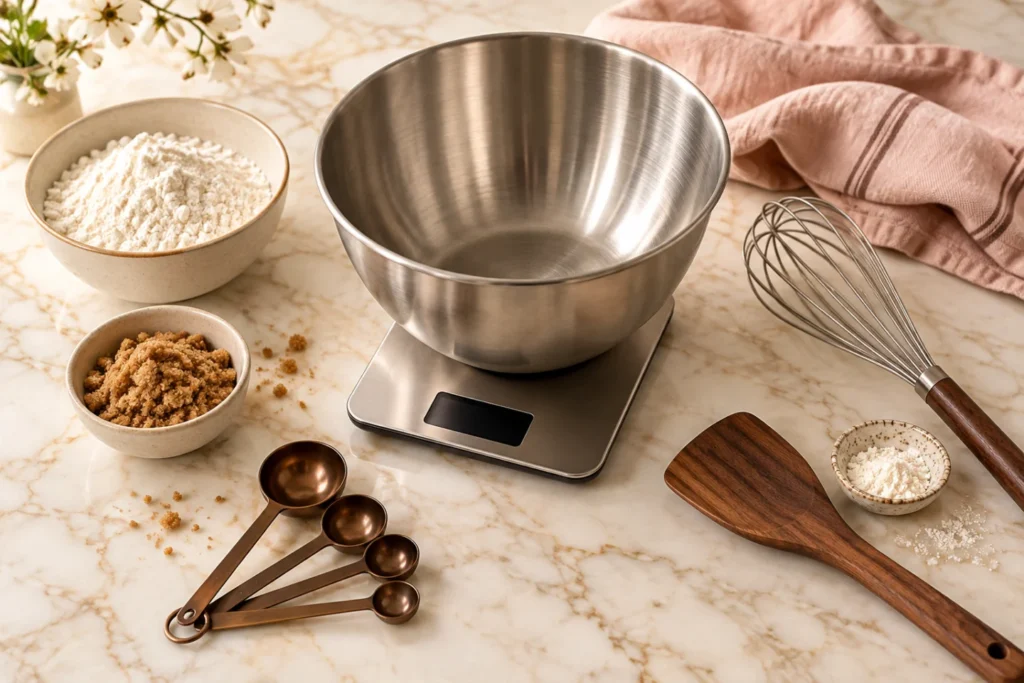
A useful baking kit is a collection of dependable tools, not a room full of gadgets. Begin with the jobs you need to perform: measure, mix, shape, bake, and cool. Understanding those jobs makes equipment choices easier and helps explain why the same ingredients can produce different results in different kitchens.
Measure before you mix
A digital scale lets you repeat a formula without wondering how tightly a measuring cup was filled. Choose one that can switch between grams and ounces, place it on a stable counter, and learn its tare button. Taring removes the weight of the bowl so the display represents the ingredient you are adding.
Keep measuring spoons as well: a large kitchen scale may not resolve very small amounts reliably. A separate liquid jug is convenient for pouring, but read its markings at eye level. More expensive equipment is not automatically more accurate; consistent technique and a sensible measurement range matter.
Choose bowls and utensils for the task
A roomy mixing bowl keeps flour from spilling and gives a spatula space to scrape the bottom. A whisk distributes dry ingredients and combines loose liquids; a flexible spatula folds and scrapes. A sturdy spoon can handle many cookie doughs. A hand or stand mixer is helpful for repeated creaming or whipping, but it does not replace stopping to inspect the mixture.
Look for tools that are comfortable to hold and easy to clean. Scratched or damaged equipment deserves attention, particularly where food becomes trapped. Keep raw-ingredient utensils separate from tools used to serve finished desserts.
Treat pans as part of the recipe
Pan size changes the depth of a batter, so a smaller pan is not a neutral substitution. Measure the inside dimensions and note whether the recipe specifies metal, glass, or another material. Use the prescribed pan first before experimenting with alternatives.
For cookies, a flat, light-colored metal sheet is an uncomplicated starting point. Parchment helps with handling and cleanup when suitable for the recipe and its temperature. Parchment is not wax paper: check the package instead of assuming the products are interchangeable.
Make cooling and checking easier
A cooling rack allows air around baked goods instead of trapping warmth against a solid surface. An oven thermometer helps you observe whether the displayed setting resembles the temperature near the food. Neither tool removes the need to inspect the bake at the recipe’s stated checkpoints.
Use dry oven mitts and a heat-safe landing place for hot pans. Put your timer where you will hear it, and record both the recipe’s suggested time and the time your own batch needed. That small record is often more valuable than another specialty gadget.
Put it into practice
- Start with a scale, spoons, two bowls, a whisk, a spatula, a suitable pan, and a rack.
- Check your pan dimensions before buying ingredients.
- Read care and temperature limits on parchment, mats, and bakeware.
- Record which tools worked well before expanding the kit.
Buy for the next useful skill, not for an imagined perfect kitchen. A small kit used thoughtfully supports better learning than a large collection whose jobs overlap.
References & further reading
References inform factual checks and further reading; article wording and development commentary are original. Recipe drafts are not kitchen-tested.